
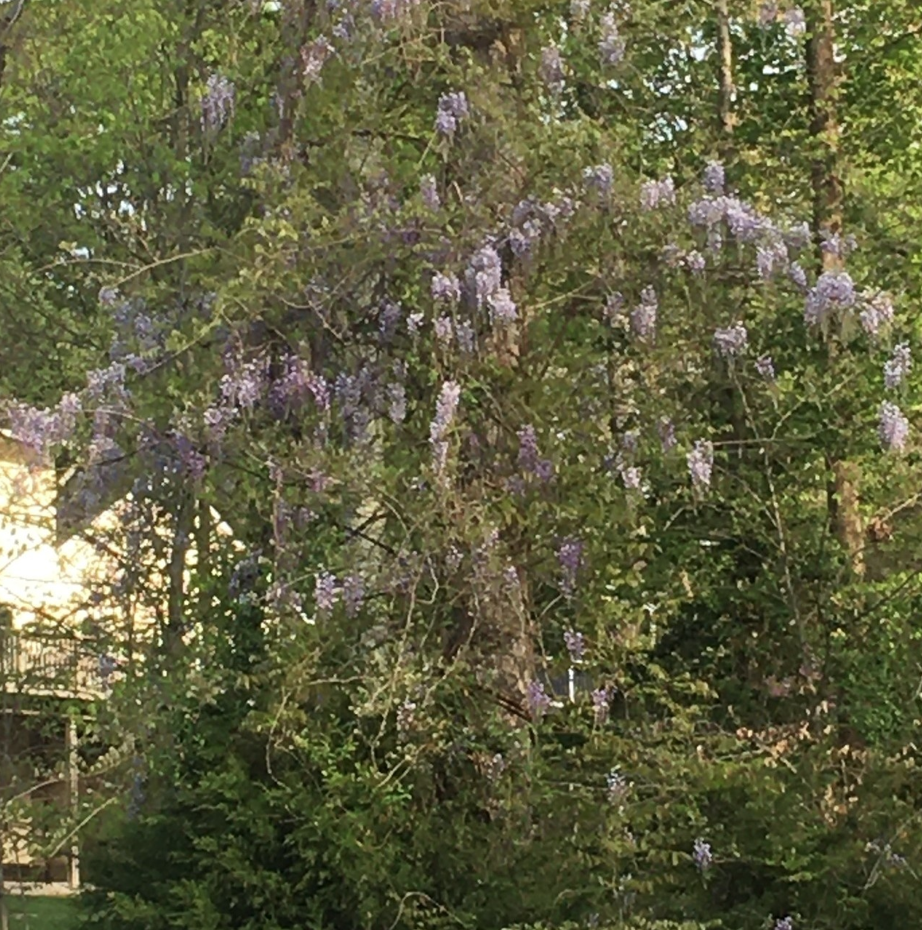
Chinese and Japanese Wisteria may look romantic—long, fragrant purple flower clusters and fast growth that covers arbors and fences. But the romance quickly sours as homeowners learn too late that this vine doesn’t stay where it’s planted. Once it gets going, it can twine up trees, smother shrubs, and create dense, tangled thickets that are extremely hard to remove.
Removing this plant is a high priority for our community-wide effort to save the trees. The damage it causes is horrendous, yet unlike some other invasive species that are now everywhere, there are few enough infestations in Fairfax/Falls Church that we should not only be able to manage it but to eradicate it, if enough people take action.
What is it? Why don’t we like it?
- Asian Wisteria grows rapidly, twining clockwise around anything it can reach—trees, fences, porches - and strangling them with a vice-like grip, tearing trees limb from limb and snapping off their tops
- The vine spreads aggressively, sprouting into shrub-like tangles.
- Wildlife does not use the plant because the seeds are too large, and the seeds themselves are poisonous if eaten raw.
How can you identify it?
- Leaves: Bright green and compound (meaning a leaf made up of leaflets)
- Flowers: Long, drooping clusters of pink to purple, very fragrant blooms in spring.
- Seed pods: Velvety, flattened pods long that ripen in fall
- Stems: Green to gray, thickening into ropes with age
How can you remove it?
- Removing Asian Wisteria takes years of repeated effort.
- Cut vines at the base and kill the roots. For a very small infestation, digging out might be possible. What is usually required is to cut the vine less than six inches from the ground and paint the stump with herbicide. See this article for details.
- Remove surface runners
- Monitor regularly: New shoots can appear for years after removal.
What should you plant instead?
Native alternatives that fill a similar niche include:
- American Wisteria (Wisteria frutescens). Native to Virginia, though not to Fairfax.
- Crossvine (Bignonia capreolata)- orange flower.
- Coral Honeysuckle (Lonicera sempervirens). Red flowers, a hummingbird magnet!
- Virgin Bower (Clematis virginiana). Easily confused with the invasive Sweet Autumn Clematis (Clematis ternifolia)
